
Mária Telkes facts for kids
Quick facts for kids
Mária Telkes
|
|
|---|---|

Telkes in 1956
|
|
| Born | 12 December 1900 |
| Died | 2 December 1995 (aged 94) Budapest, Hungary
|
| Other names | Sun Queen |
| Education | University of Budapest, Ph.D. Physical Chemistry |
| Known for | Solar Energy Technologies |
| Board member of | Solar Energy Society |
| Awards | National Inventors Hall of Fame, Society of Women Engineers Achievement Award, National Academy of Sciences, Building Research Advisory Board Award |
| Engineering career | |
| Discipline | Physics, Thermoelectricity |
| Institutions | Cleveland Clinic Foundation, Westinghouse, Massachusetts Institute of Technology, New York University, University of Delaware |
| Projects | Water-powered Desalination machines, Dover Sun House, Solar powered oven |
| Significant advance | Solar heating, cooling, and thermal storage systems (several patents) |
Mária Telkes was a brilliant scientist, engineer, and inventor who loved solar energy. People often called her the Sun Queen because she found ways to use sunlight. She worked as a biophysicist to study living things and energy. During her long career, she created heating machines that were environmentally friendly. She believed that sunshine could help people power their homes every day.
Telkes moved to the United States and joined the Massachusetts Institute of Technology (MIT). There, she studied solar thermal storage to save heat for cold nights. She also designed a clever solar water distillation device that saved many lives. Later, she helped design the famous Dover Sun House with architect Eleanor Raymond. Her amazing work earned her a place in the National Inventors Hall of Fame.
Contents
Early Life and Growing Up in Hungary
Mária Telkes was born on December 12, 1900, in Budapest, Hungary. Her family had deep roots in the Jewish community. Her grandfather was named Simon Telkes. In 1881, her family embraced Hungarian naming traditions and changed their family name. Later, her father joined the Unitarian church. Her family was eventually welcomed into the Hungarian nobility.
Mária showed a deep curiosity about science as a young girl. She even built her very own chemistry set at home when ten years old. Her father encouraged her exciting experiments and questions about the natural world. She attended school in Budapest and decided to study physical chemistry in college. During her first year of college, she read a book about future power sources. The book inspired her to dream of new ways to capture energy.
She studied hard and earned a college degree in 1920. She stayed at the University of Budapest to earn a doctoral degree in 1924. While finishing her degree, she taught physics classes to university students. After graduation, she taught briefly at the University of Geneva. She soon traveled across the ocean to visit family living in Cleveland, Ohio. After seeing America, she decided to make it her new home.
Early Scientific Career in America
Telkes arrived in the United States in 1925 to begin her career. She took a job with the Cleveland Clinic Foundation in Ohio. Biomedical researcher George Washington Crile led the research team there. Telkes studied how living cells produce electrical energy. Together, they invented a photoelectric device to measure and record brain waves. She even helped write a scientific book about life processes.
In 1937, Telkes proudly became a citizen of the United States. She then moved to Pennsylvania to work for the Westinghouse Electric company. She studied how an alloy, or metal mixture, behaves when heated. She used thermocouples to turn captured heat directly into usable electricity. She wanted to find better ways to power homes without burning dirty fuels.
She joined the Solar Energy Conversion Project at MIT in 1939. This team researched thermoelectric devices powered entirely by clean sunshine. She worked at MIT for thirteen exciting years as an associate research professor. Her projects proved that the sun could produce clean power for regular families.
Solar Inventions That Changed the World
Mária Telkes was a creative problem-solver who held about twenty official patents. She designed machines that could trap solar heat and save it for later. Her work helped solve many serious challenges around the world.
Life-Saving Clean Drinking Water
During World War II, government leaders asked Telkes to help the country. She joined the team at the Office of Scientific Research and Development (OSRD). Military pilots and sailors sometimes crashed into the ocean and needed fresh water. Telkes designed a clever desalination kit that floated on the ocean surface. The device used pure sunlight to turn salty seawater into clean drinking water.
The machine was like an inflatable plastic balloon that absorbed solar rays. Sunlight warmed the salt water inside, creating clean vapor that left salt behind. Her team completed the first working model of this tool in 1942. However, a researcher named Hoyt C. Hottel delayed the manufacturing contracts. The military finally gave the kits to troops near the war's end.
These floating water makers saved the lives of many lost airmen and sailors. Telkes later adapted this system to help the US Virgin Islands. In 1945, the government gave her a special Certificate of Merit. In 1952, the Society of Women Engineers gave her their first Achievement Award.
Storing Solar Heat in Materials
Telkes knew that the sun does not shine at night or on cloudy days. She called thermal energy storage the biggest puzzle for solar engineers to solve. She became an expert in special substances that shift form to hold heat. These materials absorb lots of warmth when melting and release it when hardening.
She decided that Glauber's salt, also known as sodium sulfate, was the best material. When warm sunlight hit the salt, it melted into a warm liquid. When the air cooled down, the liquid turned solid and released cozy warmth. Fund manager Godfrey Lowell Cabot loved her ideas and supported her work. However, other MIT scientists, including Hottel, doubted that her chemical systems would work.
Despite some disagreements at MIT, university president Karl Compton supported her efforts. She continued testing different chemicals that could store warmth safely in buildings. Her research helped modern engineers build better solar heating systems.
The Famous Dover Sun House
In 1948, Telkes helped build a revolutionary home called the Dover Sun House. She teamed up with architect Eleanor Raymond in Dover, Massachusetts. Philanthropist and artist Amelia Peabody paid for the construction of the home. It was one of the very first houses heated entirely by sunlight.
The home had large glass windows that faced the bright southern sky. Sunlight warmed the air trapped behind the glass panels on the second floor. Electric fans then pushed this heated air into metal storage boxes. The boxes were filled with sodium sulfate salt and built inside the walls. As the melted salt cooled down, it released steady heat into every room.
Crowds of curious visitors and news reporters came to see the house. The magazine Popular Science praised the house as a wonderful achievement for humanity. The solar heating system worked very well for the first two years. By the third winter, however, the salt separated and containers began to leak. The owners removed the salt tanks, but the house proved solar heating worked.
Cooking Food with the Sun
Telkes began working at New York University in 1953. She received a grant from the Ford Foundation to build a solar powered oven. Many poor families around the world lacked electricity or wood for cooking. Telkes wanted to build a simple cooker that anyone could easily use.
Her oven used an insulated box, four shiny mirrors, and a glass lid. The mirrors reflected bright sunlight into the dark box to trap heat. The oven quickly reached 350 degrees Fahrenheit in just thirty minutes. It cost only five dollars to make, so poor families could afford it. Even young children could safely cook food using her clean solar oven design.
Later, Telkes helped design materials for the Apollo mission to the Moon. Her special chemical materials protected delicate equipment inside Polaris missiles from extreme temperatures. She also worked for private companies, including Curtiss-Wright and Melpar, Inc.
In 1969, she joined the faculty at the University of Delaware. There, she studied photovoltaic cells that turn sunlight directly into green electricity. She helped build Solar One, a house generating both solar heat and electricity. Later, she helped the US Department of Energy design the Carlisle House in Carlisle, Massachusetts.
Awards and Lasting Legacy
Mária Telkes received many prestigious honors throughout her long life. In 1964, she spoke at the International Conference of Women Engineers and Scientists. The International Solar Energy Society gave her the Charles Greeley Abbot Award in 1977. She also earned a high honor from the National Academy of Sciences. In 2012, she was inducted into the National Inventors Hall of Fame.
Scientists even named an asteroid 390743 Telkesmária in outer space after her. On December 12, 2022, her work was celebrated with a special Google Doodle. PBS told her life story in an American Experience documentary film called The Sun Queen. She spent her life proving that clean solar energy can power our world.
She died in Budapest on December 2, 1995, at the age of ninety-four. Today, her original research papers rest at the Arizona State University library. Mária Telkes showed the world how to use the power of the sun.
Images for kids
-
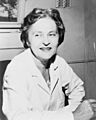
Mária Telkes working in her laboratory in 1956
See also
 In Spanish: Mária Telkes para niños
